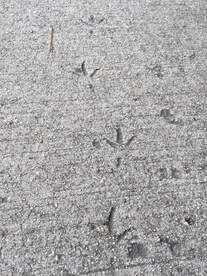
Walking down Somerville Avenue yesterday, on my way to the T station, I noticed bird tracks set in sidewalk concrete. They were too big for little birds, and not arrayed in the hop-hop pattern you see with sparrows and robins. A quick check on Google confirmed it: wild turkey tracks. These tracks were set about eight inches apart, indicating a casual trot. They reminded me of dinosaur tracks, and of course we all know that birds are descended from dinosaurs. Will they meet the same fate someday? Impossible, you say, especially for those wild turkeys making themselves a nuisance on golf courses and across suburban parks. In fact, wild turkeys are doing fine in New England, although their numbers are starting to fall off nationally after a strong resurgence in recent decades. The reasons for the decline are manifold and include more frequent and intense spring storms, related to climate change, that kill off hens and offspring.
Birds in general, however, are faring poorly in the Anthropocene. According to a recent study in the journal Science -- which you can't read unless you're a subscriber, so here's a NYT article about the study -- the bird population of North America has fallen 29 percent in the past 50 years. That's almost three billion fewer birds in the skies over the U.S. and Canada since I was an eight-year-old child watching woodpeckers, crows and finches in the backyard with my grandfather. In the evening, we'd listen for the rapid call of the whip-poor-will. Sometimes I'll still absently make that call as I'm walking alone, and I always listen for a call-back and never hear one.
It's not just exotic birds; common species such as robins, starlings and sparrows are taking big hits. The major culprits is us, of course -- specifically, human development encroaching on bird habitats and widespread use of pesticides. (In a cruel twist, pesticides known as neonicotinoids reduce the appetite of sparrows, causing them to slowly starve to death.) The connection to climate change can be specific; for instance, many migrating birds return in springtime to find conditions on the ground altered. Early onset of spring due to climate change can mean that the usual food sources have come and gone. The connection to climate change is general, too. All the expansionist, industrial activities that produce climate change also make the world less hospitable to birds.
House cats allowed to roam outside, poorly-sited wind turbines and glass skyscrapers also contribute to bird death. Three more things we're responsible for.
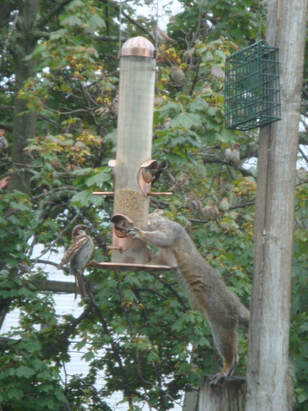
Anecdotally, fewer sparrows visit the feeder in my backyard these days. It used to be a feasting frenzy some mornings; now it's a casual brunch with friends -- until, that is, an impetuous squirrel comes by to jazz up the party. Thankfully, the family of starlings in one of our roof eaves are still camped there, and cardinals, mourning doves and blue jays continue to drop by. Blue jays often make a discordant, scraping call that sounds like the opening and closing of a rusty gate. It's a vaguely disturbing sound, repeated over and over and over. I wonder if they're trying to tell us something.
It's not just exotic birds; common species such as robins, starlings and sparrows are taking big hits. The major culprits is us, of course -- specifically, human development encroaching on bird habitats and widespread use of pesticides. (In a cruel twist, pesticides known as neonicotinoids reduce the appetite of sparrows, causing them to slowly starve to death.) The connection to climate change can be specific; for instance, many migrating birds return in springtime to find conditions on the ground altered. Early onset of spring due to climate change can mean that the usual food sources have come and gone. The connection to climate change is general, too. All the expansionist, industrial activities that produce climate change also make the world less hospitable to birds.
House cats allowed to roam outside, poorly-sited wind turbines and glass skyscrapers also contribute to bird death. Three more things we're responsible for.
Anecdotally, fewer sparrows visit the feeder in my backyard these days. It used to be a feasting frenzy some mornings; now it's a casual brunch with friends -- until, that is, an impetuous squirrel comes by to jazz up the party. Thankfully, the family of starlings in one of our roof eaves are still camped there, and cardinals, mourning doves and blue jays continue to drop by. Blue jays often make a discordant, scraping call that sounds like the opening and closing of a rusty gate. It's a vaguely disturbing sound, repeated over and over and over. I wonder if they're trying to tell us something.
 RSS Feed