THE TREE LINE
  • Just Warming Up
  • Here and Beyond
  • Journey Out of Darkness
  • Monadnock Blog
  • Dachau and Climate Change
  • Generation Chasm

Just Warming Up

Thoughts on Life in the Anthropocene

Procrastination

1/24/2020

1 Comment

 
PictureYale President Peter Salovey
While lounging on the couch recently, my sore, surgically repaired arm cradled on pillows, I picked from the coffee table the most recent issue of the alumni magazine for Yale University. (My wife earned her undergraduate degree there, a few decades ago.) Whoa, the blazing orange cover almost burned my corneas as the scorching red headline announced: It's getting hot. Climate change, see inside.

​Yale, we learn, has pledged to go carbon neutral by 2050. At first blush, that sounds pretty good. Way to go, Yale, boldly determined to set a shining-green example for other incredibly wealthy and privileged institutions in just 30 years...wait a second, that's pathetic. Thirty freakin' years? Peter Salovey, the current president, will soon turn 62. At age 92, we presume, he'll be rolled on stage and feted by the Yalies of 2050 for his marvelous if deliberate plan to chip, chip, chip ever so slowly, let's not be hasty, at the existential crisis that supposedly is climate change. In the meantime, we'll always have this issue of Yale, featuring perfectly nice articles about climate change endeavors at the old alma mater. President Salovey, by all accounts a mensch,  contributes a back-slapping letter about the university's groundbreaking (with a teaspoon) efforts. Solar panels and composting! Compostable solar panels! As if anticipating objections, he's even employed a "task force" to explore the question of speeding up the process a wee bit.   

C'mon, Peter, you've got a $30.3 billion endowment! Some of the smartest people on the planet! I'm not going full Greta on you -- the amazing Ms. Thunberg this week told the assembled elites at Davos to stop the nonsense now, not by 2050, now -- but you can do better than this. Boston University, with its measly $2.2 billion endowment, has set its carbon-neutral sights on 2040. Just call up President Brown and he'll tell you how to do it by purchasing wind power in South Dakota.

So, for Yale, let's say 2030. That's within the university's epic grasp, don't you think? Oh, and check out this awesome poster that BU students put together. Your turn, bulldogs.       

Picture
1 Comment

Bitcoin, Greencoin, Carboncoin, Birdcoin

1/8/2020

0 Comments

 
PictureGeorge Orwell Would Not Approve
The previous post explored the ruinous environmental effects of the cryptocurrency called bitcoin. The pollution caused by digital bitcoin "mining" -- greenhouse gas emissions, as well as conventional, fatal dispersal of toxic elements and smog -- is called in the economics biz an "externality" or "external diseconomy." Top-level euphemisms, both, right up there with "collateral damage," "enhanced interrogation techniques" and "billiard academy." Mr. George Orwell would not approve. Some "progressive" economists, however, "get real" by using the term "negative externality."

Enough with the quotes, Still, it's a crazy world in which I'd be arrested for dumping a barrel of garbage on my neighbor's lawn, but if I send a million barrels of trash up a smokestack and injure countless people bit-by-bit, over time, that's okay. One reason such blatantly anti-social behaviors are accepted is the sterile, soulless language of economics. Anything outside the producer-consumer transaction is by definition external -- tangential, lacking in importance. And therefore not incorporated into economic statistics trumpeted by the economics "profession" (sorry) and its lackeys in the mass media. Two classic, moldy examples are Gross Domestic Product and Average Income, common barometers that are, respectively, heedless of the destruction wrought by fossil-fuel powered economic growth and the cruel facts of income inequality.

As an economist might have drawled in the movie Cool Hand Luke, what we have here is a failure to internalize negative externalities. Or just be human. Take responsibility. 

PictureLibrary Book, in Domestic Context
Back to bitcoin. Its production relies on the "proof of work" concept, in which an action has to be physically performed in order to create the currency. With bitcoin, that activity is wasting electricity and accelerating climate change. So I wondered, why can't we have a greencoin? Why can't its "proof of work" come in the form of sustainable or eco-healing behaviors such as reforestation or renewable energy development? So I Googled; yes, greencoin exists. Then I happened to be reading Kim Stanley Robinson's wonderful new novel Red Moon, which mentions something called carboncoin. Turns out, in the year 2047, a couple hundred million Americans transfer their saving from the big banks into carboncoin, a cryptocurrency that is mined by taking carbon out of the air. Did Robinson make this up? So I Googled again; carboncoin exists, too. Warning: the linked article in the previous sentence, written by a person/consortium named AxisMundi, reads like a cross between a boring economics text and the Unibomber's manifesto.      

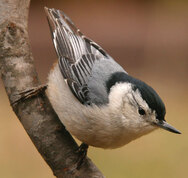
PictureWhite-breasted Nuthatch = .00001252 birdcoin
Now I wonder once more, why not birdcoin? (I have not Googled it, therefore it may not exist.) Instead of miners, this cryptocurrency would have birders. Birdcoin birders would enact "proof of work" by going for walks and spotting birds, then watching them. Enjoying them. Being moved by them. And that's a good thing because, in the words of novelist Margaret Atwood, who knows a few things about dystopia and its possibilities, "If you follow birds, it allows you to get a pretty global view of what's happening to the planet." (See Audubon magazine, Winter 2019.) Birdcoin, let's wing it!

0 Comments

Absurdocoin

1/3/2020

0 Comments

 
PictureIt's a byte, actually, not a coin
The recent killing by American drones of Iran's powerful  General Suleiman, a terrorist mastermind on par with Osama bin Laden, has supposedly led to a flood of speculation in the cryptocurrency known as bitcoin. Bitcoin shot up five percent, according to Forbes, as wise guys and fraidy cats sought safe harbors in case stocks and bonds cratered due to war in the Middle East. That's the scoop, at least. I don't pretend to really understand bitcoin. I have a hard time grasping its basic concept, no less the sense behind it. And I suspect it's a sucker's bet, a techno-fantasy for conspiracy theorists and uber-nerds. The heavy involvement in bitcoin by the Lunkhead Twins, I mean Winklevoss Twins, is a head-scratcher. But, again, who knows. High techno-finance, the realm of amoral equity-fund mandarins  and sell-out physicists -- a two-handed head-scratcher. 

However, there is no doubt about this: the bitcoin enterprise emits about 23 megatons of carbon every year, the equivalent of 1.2 million transatlantic flights. Bitcoin, whether it's booming or busting, results in a massively irresponsible waste of energy that is helping to fuel climate change. 

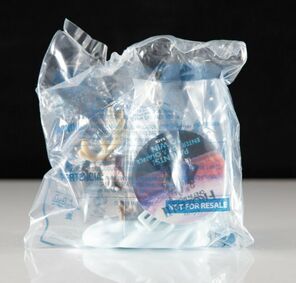
PictureFrozen 2 Movie Happy Meal Toy #4 -- sealed in plastic, of course
Why does it take so much energy to make bitcoin? The answer is complicated and not immediately apparent. This Investopedia article does a nice explaining the history and mechanics of bitcoin, but fails completely to note its environmental impact. It does relate how bitcoin miners at their high-powered computers compete to "produce" bitcoin and gain bonuses by solving vastly complicated math problems. Remember, there is no social purpose behind this computational Olympics; nothing tangible is made. Only bitcoin is made, sorta. The jacked-up computers of bitcoin miners run hot and hard, jumping through mathematical hoops, in order to satisfy "proof of work" principles and therefore imbue bitcoin with some hypothetical kind of value. The miners could just as well run marathons or help little old ladies across the street (without bilking them of their savings, we hope), but instead they expend massive amounts of electricity. 

Some bitcoin miners counter that they use renewable energy. Sure, fine, but that renewable energy could flow elsewhere to businesses that actually employ people and make things if the ridiculously wasteful and absurd pursuit of bitcoin mining did not exist. Then there's the deeply philosophical argument that burning coal to produce bitcoin is no worse than burning coal to make toys for McDonald's Happy Meals. Maybe, maybe not -- hey, here's an idea. Let's ban both practices -- the manufacturer of bitcoin and crappy plastic lumps of Frozen ​moose. 

So, let's recap. At a time in human history when we urgently need to come up with new, inventive ways to drastically reduce our global carbon footprint, the barons of cryptocurrency have devised a new and inventive way to raise our global carbon footprint. Yay bitcoin, buy it now!!     

0 Comments

    Author

    Hal LaCroix has been a newspaper reporter, magazine editor, PR professional, book author, environmental advocate and college instructor, among other endeavors. He lives in Somerville, Mass. with his wife Elahna. 

    Archives

    February 2026
    January 2024
    October 2023
    April 2023
    March 2023
    January 2023
    December 2022
    November 2021
    August 2021
    June 2021
    May 2021
    April 2021
    September 2020
    August 2020
    February 2020
    January 2020
    December 2019
    November 2019
    October 2019
    September 2019

    Categories

    All

    RSS Feed

Proudly powered by Weebly