THE TREE LINE
  • Just Warming Up
  • Here and Beyond
  • Journey Out of Darkness
  • Monadnock Blog
  • Dachau and Climate Change
  • Generation Chasm

twelve times up


my great granite friend


Button Text

January 19, 2015

2/9/2015

Comments

 
Picture
On the frigid peak enshrouded in racing, white cloud, the mountain zipped up in a coat of furry rime-ice, I meet a man wearing a Scottish kilt. It’s a green-and-gold tartan number, over blue jeans. Today is his 60th birthday and in celebration I give him a Nutter Butter cookie made, says the box, with real peanut butter. Oh thank you, he pipes, as if it’s the final piece in life’s confounding puzzle. We stamp our feet and munch our cookies down.

Let’s go back five hours. I’m leaving my house in Somerville, 12 feet above sea level, and I step off the front walk onto an ice-slick flagstone – whoosh, yikes, my limbs go spastic. Somehow, I recover before falling. At least I didn’t snap or tear anything. So I get in the car, not realizing that I’ve forgotten my camera, and my wife comes out to wave me away, as is our custom; whoever leaves first in the morning gets a big porch wave from the remaining spouse, regardless of the weather outside or inside the house. Today she wears her supportive, worried expression.
Picture
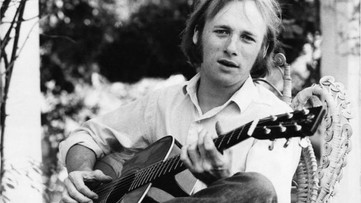
Halfway to New Hampshire, the oldies station gives me Stephen Stills warbling, “Stop, hey, what’s that sound, everybody look what’s going down,” and while I can’t remember the name of the song (For What It’s Worth) or the group (Buffalo Springfield), I do recall Stills’ solo concert at Boston College when I was a student there in 1981. He came on stage drunk or high and stumbled around playing incoherent guitar and mumbling lyrics. Alas, no Crosby, Nash, or Young provided harmony, no Wooden Ships sailed across the Roberts Center gym that’s since been demolished for a science building. He seemed old and broken-down at age 36.  (Now at age 60, he’s sober and still touring.)

Today my weather app calls for sun, but everything’s socked in. Mount Monadnock hides in grayish clouds with a yellow, sulfurous tinge from wood stoves cranking since dawn. Six cars dot the parking lot. By 10:40 I’m geared up and going up, too.

The ice on the trail is thicker than last month, a translucent seal. Underfoot, black boulders appear like surfacing turtles, like sea monsters frozen in mid-escape. When I stop to rest and hydrate at the Cascade Link turnoff, a young woman skitters by. She's stripped down to a sleeveless t-shirt; I’m wearing three layers plus coat, wool hat and fleece gloves over a new pair of runner’s gloves with metal-fiber fingertips for fine-motor activities like tapping cell phone buttons or unwrapping the short sleeve of Nutter Butters in my pack. I wave to her, unzip my coat a bit.

With a temperature of 33 degrees at the base, and no storms forecast, this won’t be a day for perishing on the mountain. Only one hiker has died of hypothermia here, according to Monadnock: More than a Mountain. That poor soul was Charles MacVeagh, Jr., a 23-year old Harvard College graduate whose family owned a house in nearby Dublin. MacVeagh had climbed Monadnock hundreds of times, and so there was nothing unusual on the afternoon of Valentine’s Day, 1920, when he and friend Charlton Reynders took the Dublin Trail toward the peak. The sky was sunny and blue-jay blue, in the 50s, so they left behind their fur-lined coats and gloves. Just a February lark and back for supper! Then a freak blizzard arose and a tragic series of events followed. Poor Reynders saved himself by firing his revolver into the air, attracting the attention of Frederick Nettleton, the caretaker of the MacVeagh house, who had set out after dark to find them.     

Read More
Comments

December 5, 2014

2/9/2015

Comments

 
Picture
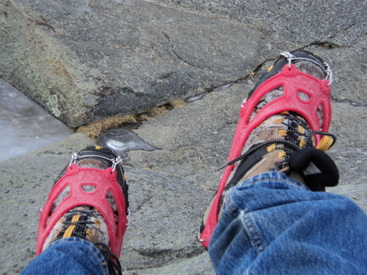
This time, I’ve prepared better. I climb with my asthma inhaler, bandages, digital camera instead of iPod and a short sleeve of classic black Oreos, not golden ones, not minty ones, and certainly not the Double Stuf variety that upends the universe’s stuf-cookie ratio. I also bring a fleece hood (balaclava), extra sweatshirt, two pairs of gloves and a shiny pair of spikes for my boots. (The Kahtoola MICROspikes Traction System, in fact.) They look like futuristic spats, with a rubbery red girdle around the ankle supporting a net of chain-metal teeth biting below.

This time, I also leave Somerville early and cross into New Hampshire before 10 a.m. At a country store there’s a Dunkin' Donuts secreted within and I fuel up with java and a slobbery breakfast sandwich thing. Four beefy hunters in cammo gear sprawl across plastic chairs. Done for the day or just starting, I’m not sure. I make the mountain by 10:30 and all of five cars sit in the lot. Yes, Mount Monadnock may be one of the most popular climbing destinations in the world, but not today. And now for a good slap at Mount Fuji.

Fuji, outside Tokyo, claims to be the world’s most-climbed mountain. It gets an estimated 200,000 visitors each year, compared to 100,000 for Monadnock. Okay, fine, but what does it mean to climb a mountain? At Fuji, the trails are marked not with paint swipes and dabs on rocks and trees, nor with the noble rock towers called cairns. No, Fuji’s trails are lined with iron chains between posts, designed to keep Fuji trudgers on track. Fuji has trailside huts with hot tea and rooms for napping. There’s a visitor center on top! Sure, it’s almost four times as high as Monadnock, but you can drive halfway up. The “anonymous monk” who bagged the peak in 663, he climbed a mountain. Last year’s Fuji-toppers, not so much.

Today the White Dot Trail is a rocky, icy snake and the woods are ground-covered with crusty snow, glowing in patches of sun.  The random, cross-cutting shadows of tree trunks draw black, irregular lines on the white. Five minutes up, a kid in his 20s long-strides past me. He wears running shoes with neon-yellow strips. “Wow, sneakers,” I say and he responds that he left his boots “in the trunk of my car and I might regret it.” (So go back, I don’t say, and get them.) “I might not make the top,” he adds, as if it doesn’t matter that much. He disappears up the trail.

Picture
Thirty minutes in, I rest on a flat, sun-streaked rock in the vicinity of Falcon Spring, just south of the turnoff to Cascade Link Trail. According to the book Monadnock: More than a Mountain, by Craig Brandon, the spring has been “a landmark for over two centuries” and was first called Bubbling Spring. Then it got renamed for William Falconer, “the original forest fire lookout watchman” on the mountain. I like the sound of that: forest fire lookout watchman. Snow’s melting here, a faint tickling, and the rustle of leaves in the wind is like a hand brushing lint from a shoulder. A guy goes by in his MICROspikes and I think, hell, why not, time to put mine on.

It’s an easy adjustment; the spikes grip the ice firmly and don’t get caught on the release. Just like that, I’m ripping along. At first I enact a reverse hiking protocol, avoiding rocks in favor of snow and ice, but soon I stop worrying about blunting the spikes and just climb over dirt, mud, granite and slush, up ice inclines, into snow cavities, across anything and everything. And I get to wondering about Interstellar, G-d knows why, imagining myself defending the movie to a former colleague at Boston University who raved about some pedantic, mediocre film in which a jerky college professor plays bongos in the subway…let it go, Hal, let it go…and it’s not just the amazing visuals, the echoes of 2001, the All-American pluck of Matthew McConaughey and Anne Hathaway that I enjoyed so much. Interstellar expresses the anguished gulfs between people in conflict and especially between people in conflict who love each other.

Many years ago I was a movie reviewer for the Worcester Telegram and Gazette. They paid me a pittance to type overwrought stuff like this: The gaps between characters in Interstellar are as galactic as the space-ocean McConaughey traverses. Love in Interstellar doesn’t so much redeem or transform, but sends out stealthy homing signals. It’s about seeking, striving, losing, enduring. Fear not, we’re entangled on the quantum level even as we speak to each other face to face without understanding.

And the robots. The fence-post robots are totally cool.

Around noon I sit on a stone mesa, and off come my sweat-soaked gloves and hat. Here’s the day’s first mitzpe – Hebrew for bird’s-eye view – a panorama of gray cloud, faraway hills and snow-clotted countryside. Closer by, several evergreens have turned a sickly pea-green, and the wind moves sideways on the mountain according to the wet index-finger test. Even though I’m not thirsty, I make myself drink. Two magnificent hawks soar above, swooping, brushing wings – playful or provocative, it’s hard to tell – and their parabolic cries fall smack-dab into my ears. Then they’re gone. Okay, up and at ‘em, and before long the trail becomes steeper, snowier, icier. Slow going and lots of fun.


Read More
Comments

November 4, 2014

2/9/2015

Comments

 
Picture
It’s one o’clock on Election Day in the USA. I’ve done my civic duty at the Dante Club in Somerville, Mass., and now I’m hiking the White Dot Trail with a splitting headache – an angry something’s been axing its way out of my skull since I clonked my dome on a doorway this morning while searching for the wristwatch I’ve worn for 15 years, and things only got worse as I ran around town car-gassing, ATMing and package-mailing. It was like being stuck in tar, but eventually I shook loose and now I’m free and moving in the chill air, happy, very happy, to be ascending my mountain again.

I breathe in, out, climb.

Behind me, at the trailhead, my car is one of 25 vehicles in the unpaved lot. It’s an uncrowded day on the third-most-climbed mountain in the world, cloudy in the 50s. I paid five bucks for admission and a map, and the ranger advised that darkness drops at 4:38 p.m. So far I’ve passed only a man shambling downhill in old sneakers and a hoodie. He grips a small bottle of water and wears no daypack. Just wandered by, went up on a whim. There’s always one of those guys.

I’ve gone up Mount Monadnock a couple dozen times. During my inaugural clamber as a freshman at Boston College – fall of 1978, a dorm field trip – I wore low-top canvas sneakers purchased at Herb’s Sports Shop in my hometown of West Hartford, Connecticut, and I sprained my ankle on the descent but said nothing, didn’t want to be the wuss. I carried a heavy crush for a young lady from New Jersey who I’d danced with the night before. The song we shared, I recall, was Start Me Up by the Rolling Stones, and such is the deceit of memory; Start Me Up and its raunchy lyrics didn't come out until the fall of 1981, my senior year. At that freshman “mixer” we probably bobbed to the flirtatious stylings of Olivia Newton-John or The Bee Gees.   

Now I veer north on the Cascade Link Trail and hip-hop stone to stone across a mellow brook, my feet wrapped in waterproofed, air-cushioned Yakota Trail Merrill hiking boots, size 13. Color: walnut with yellow streaks. Made: in China, of course. Bought: at a chain-store shoe outlet, name forgotten. Loping along in my miracle boots, I notice the brook’s surface painted with autumn leaves floating on their backs, lazily spinning. Dark green rugs of moss encircle the bases of trees. I stop; it’s all quiet, or nearly so. I stand alone here just as the mountain stands alone in its environment. Monadnock means “lone mountain” or “island mountain” in the Abenaki Indian language, and indeed it exists without brothers, a rocky knuckle jutting from rolling forests. It looms in southern New Hampshire much like Mt. Kilimanjaro rises from the plains of Tanzania.

Perhaps I exaggerate. Perhaps not. For many New Englanders with but a spark of transcendental yearning, mighty Monadnock is our Kilimanjaro.   

Picture
And then, birches. Around the corner dozens of skinny birches scatter up the slope, some alone, some in clumps of three or four. The leaves have come off surrounding oak and maple trees, so these birches really pop, shine white. It’s their glamour moment. After all, what’s better than ghost-white birches, trunks flecked with black splotches and stripes, reaching their gangly selves to heaven? These early-November birches go up, up, up. They’re making time before enveloping ice bends them astray, thwarts their ambition.

I rest my 54-year-old bones on a rock at the turnoff to the Red Spot Trail. Sunrays wheedle through cirrus clouds. I guzzle water, but the headache persists. Do I have a concussion? Wouldn’t be the first – banging into this low-flying world is a drawback of my 6’6’’ height. (Another is people informing me that I am, indeed, tall.) Why, I consider, was it so important to find that watch this morning? (It appeared a week later next to a stuffed giraffe in the attic.)  A present from Kathleen, a former girlfriend, my watch is a sweep-hand model, retro and expensive, with a wristband of silver chain links. Kathleen picked it out at the now-defunct Filene’s Basement in Boston. She loved me and I loved her and, ultimately, I let her down. Sure, I had my reasons, but still. The watch is the only thing from that period – the years between the death of my first marriage and the day I met my beloved wife, Elahna – that I carry on my person. It keeps me, I hope, humble.  

On this sunny rock I peel off my blue windbreaker and fleece, exposing a long-sleeve t-shirt. Beneath that, a regular tee. I’m layered like this forest world, its ragged garments a chaos of oranges, browns and blacks. Stray bird calls break through, clipped like afterthoughts. Bird blurts is more like it. Henry David Thoreau – who confined his Monadnock trips to spring and summer, camping beneath the boughs of red spruce trees – made his last ascension in August, 1860, two years before his death. On that hike he identified a bird that made “a dry, hard occasional chirp, more in harmony with the rocks.” Have I now heard his rock-harmony bird? Wrong time of year, sure, but things have changed a lot since then.   


Read More
Comments

    Author

    Hal LaCroix is a writer and an instructor at Boston University. He lives in Somerville, Mass. with his wife Elahna. 

    Categories

    All

    RSS Feed

    Archives

    November 2015
    September 2015
    August 2015
    July 2015
    June 2015
    May 2015
    April 2015
    March 2015
    February 2015

Proudly powered by Weebly